How AI Predicts Football Matches (Complete Guide)
Learn how AI predicts football matches using machine learning models, expected goals data, and advanced football analytics.
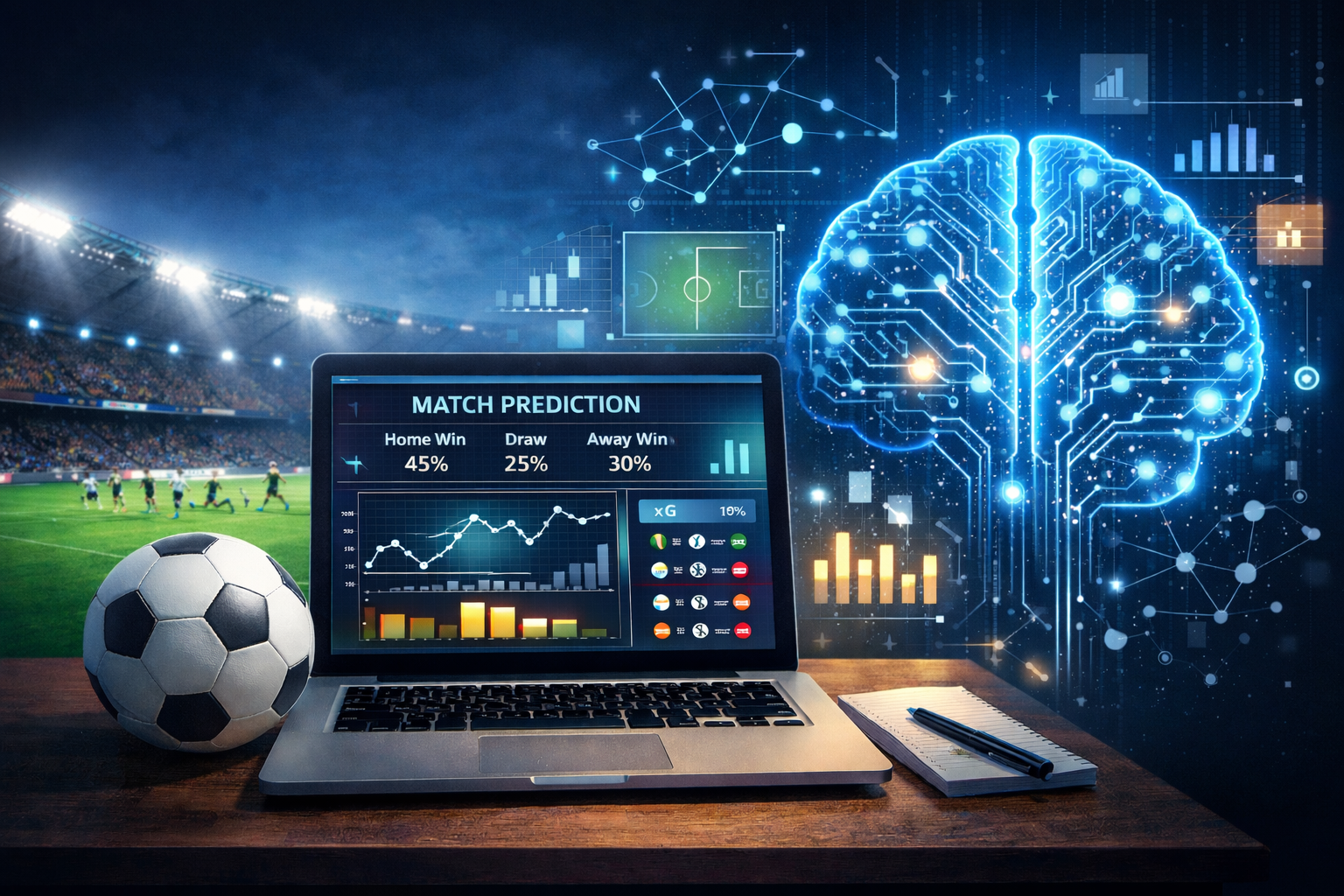
How Prodict Predicts Football Matches Using AI
Every football fan has tried to predict a match. You look at the standings, check recent form, maybe read a journalist's opinion — and still get it wrong. Human intuition is slow, biased, and limited by the data we can hold in mind at once.
Prodict changes this. Instead of guessing, Prodict uses Google Gemini AI, real-time football data, and advanced statistical models to produce structured, evidence-based predictions for matches across the world's top leagues. This guide explains exactly how that process works — from the raw data Prodict collects to the final prediction you see on your screen.
The Data Prodict Analyses Before Every Match
Accurate predictions start with accurate data. Prodict connects directly to API-Football — one of the most comprehensive football data providers in the world — to retrieve live and historical match information before every analysis run.
The key data points included in every Prodict analysis are:
- Team form — last 5–10 match results, goals scored and conceded, points trend
- Expected goals (xG) — shot quality and volume metrics that reveal true attacking and defensive threat
- Head-to-head history — last 5+ direct meetings, including scorelines and venue patterns
- Injuries and suspensions — key absences that fundamentally alter a team's strength
- Home and away splits — performance separated by venue, since home advantage is real and measurable
- Tactical metrics — possession, shots on target, pressing intensity, and defensive structure
A team may have won their last four matches but posted an expected goals figure well below their opponents in each game. Prodict catches that luck pattern — a human scanning a results table rarely does.
The AI Engine: Google Gemini
At the heart of Prodict is Google Gemini, one of the most capable large language models available today. But Prodict does not use Gemini like a chatbot. The AI acts as a professional football analyst — reading a structured data brief, identifying statistical patterns, and producing a reasoned match prediction report.
The key difference between Gemini-powered analysis and a simple algorithm is reasoning. Gemini does not just calculate probabilities; it explains why those probabilities exist. Every Prodict prediction includes a transparent breakdown of which factors drove the outcome, so you can judge the analysis yourself.
The process works in four stages:
- Data brief construction — Prodict compiles all match variables into a structured analytical brief passed to the AI.
- Contextual pattern recognition — Gemini identifies meaningful patterns: teams that underperform after European fixtures, home records under specific conditions, psychological momentum shifts.
- Probability assignment — The model assigns win, draw, and loss probabilities with confidence levels, benchmarked against historical base rates for that league and fixture type.
- Prediction report generation — A full written analysis is produced — not just a tip, but the reasoning behind it — available in English, Turkish, German, and Spanish.
What Prodict Actually Predicts
Prodict does not produce a single "home win" tip and leave you to figure out the rest. Every match analysis generates a structured set of predictions across multiple markets:
- Ideal Bet — The highest-confidence pick. The outcome Prodict considers most statistically supported.
- Value Bet — Outcomes where the bookmaker odds appear too generous compared to the true probability calculated by the AI.
- Alternative Pick — Over/Under goals, both teams to score (BTTS), Asian handicap, and correct score suggestions.
- Match probabilities — Percentage likelihood for Home Win, Draw, and Away Win so you can evaluate the analysis yourself.
Why Expected Goals (xG) Is Central to Prodict's Analysis
Of all the statistics Prodict uses, expected goals has the highest predictive value per match. xG measures the quality of every shot — based on its location, shot type, defensive pressure, and how the chance was created — and converts that into a probability of scoring.
A team that consistently generates an xG of 2.1 per game while conceding 0.8 is performing well regardless of their actual scoreline. Prodict identifies the gaps between xG and actual results to flag:
- Unlucky teams — scoring below their xG, likely to bounce back
- Lucky teams — outscoring their xG, vulnerable to regression toward the mean
- Defensive vulnerabilities — conceding high-quality chances even in matches they win
This xG context is often where Prodict's predictions diverge from conventional wisdom — and where the value is most often found.
Transparency: Prodict Shows Its Work
One of the most important design decisions behind Prodict was not hiding the reasoning. You do not just receive a "Home Win" recommendation. You receive a match report that explains the logic in plain language.
For example, a Prodict report might read:
"Manchester City are generating 2.4 xG per home game this season against 0.7 xG conceded. Their opponents have scored in only 2 of their last 7 away fixtures and are missing their starting centre-back. The home win market is well-supported by underlying data, with handicap lines offering additional value at current odds."
This transparency matters because it lets you make an informed decision. You might disagree with how Prodict weighs a particular data point. That is fine — the reasoning is there for you to evaluate, not just blindly follow.
Leagues Covered by Prodict
Prodict covers all major European leagues and a growing list of global competitions, with real-time data updated throughout the season:
- Premier League (England)
- La Liga (Spain)
- Bundesliga (Germany)
- Serie A (Italy)
- Ligue 1 (France)
- Süper Lig (Turkey)
What Prodict Cannot Predict
No AI system — including Prodict — can eliminate uncertainty from football. Some events are genuinely unpredictable, and Prodict is designed to be honest about that.
Factors that remain outside any prediction model include:
- Early red cards that reshape the match completely
- In-match injuries to key players
- Extreme weather conditions affecting playing style
- Last-minute tactical changes not disclosed before kickoff
- Individual moments of brilliance or error
Prodict is most valuable over a sample of matches, not any single game. Bettors who follow data-driven predictions consistently — rather than chasing individual results — see the clearest long-term benefit.
Conclusion
Prodict brings a level of analytical depth to football prediction that was previously only available to professional analysts. By combining Google Gemini AI with real-time data from API-Football, expected goals metrics, and transparent written reasoning, the platform gives any football fan or bettor a genuine analytical edge.
The goal is not to make football certain — it never will be. The goal is to make your decision-making more informed, more consistent, and more grounded in evidence than relying on opinion or gut feel alone.
Équipe Analytique Prodict
Ingénieurs IA Data & Prédiction
Cette analyse est produite par le modèle d'intelligence artificielle principal de Prodict. En traitant des millions de données football historiques et en temps réel, le modèle détecte les paris valeur et les avantages algorithmiques indépendamment du biais humain.